

Learning
What this achieves
Section titled “What this achieves”Learning is where your company’s own training lives — the courses you write, the assessments that check whether they landed, and the certificates that record who completed what. It also tracks what training costs and who is required to do it.
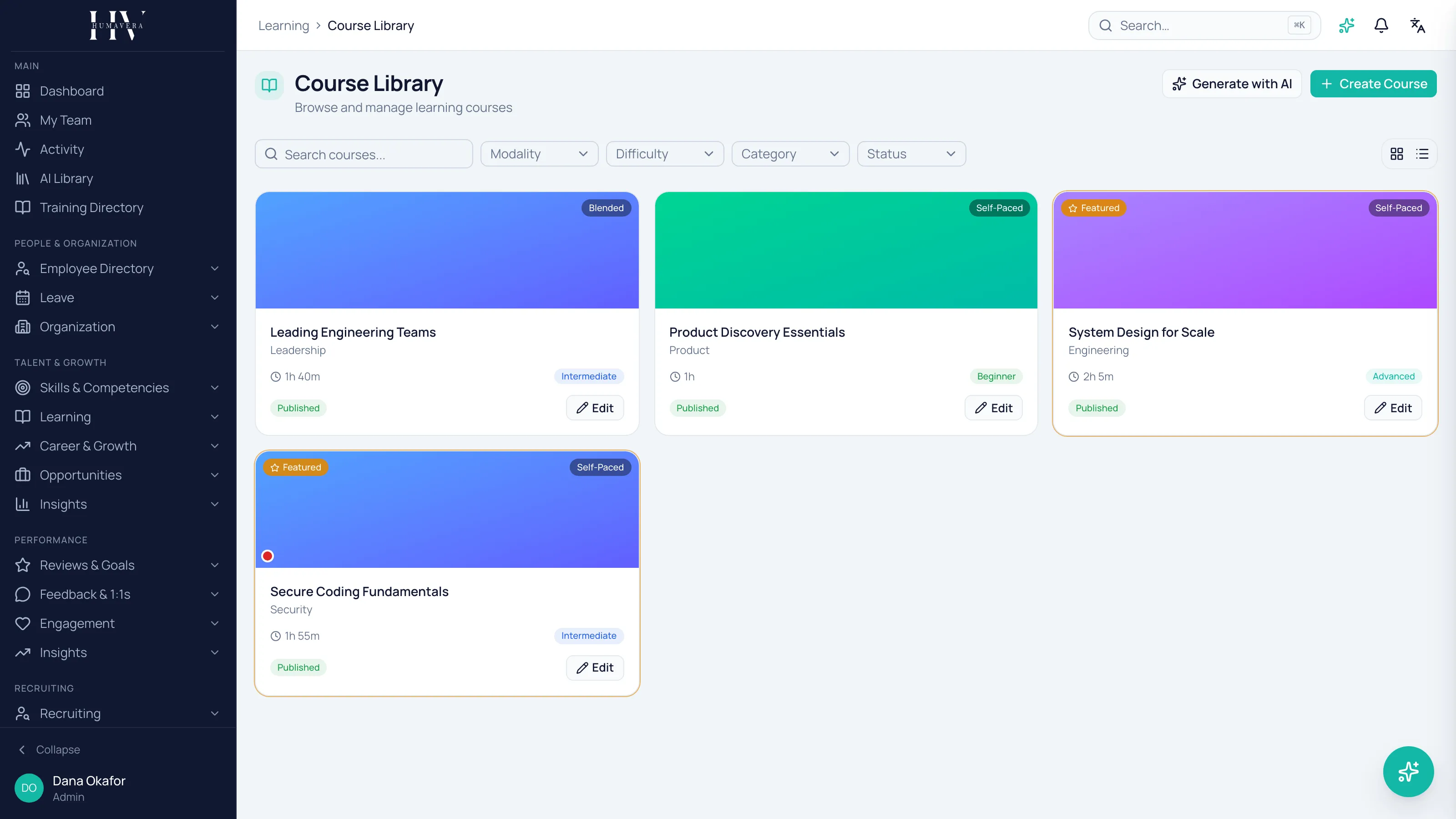
Courses are structured, not only uploaded
Section titled “Courses are structured, not only uploaded”A course is built from sections containing articles, videos, and embedded assessments, rather than being a single file someone downloads. That structure is what makes progress measurable: Humavera can report how far through a course someone is, not merely whether they opened it.
Courses can also be generated with AI from a document or a prompt, with an estimate of the credit cost shown before generation runs.
The pieces and how they fit
Section titled “The pieces and how they fit”| Option | Description |
|---|---|
| Courses | Self-paced content authored and published by your company. |
| Learning paths | Several courses sequenced into a guided journey, assigned to individuals or departments. |
| Instructor-led sessions | Scheduled in-person training with a location, a capacity, and named instructors. See Schedule an instructor-led session. |
| Assessments | Multiple choice, essay, and matching questions, drawn from reusable question banks, with auto-scoring and instructor grading. |
| Certifications | Certificates issued on completion, with expiry and renewal tracked, using designs you brand yourself. |
Example: HC Corp sequences an induction course and a compliance course into one path assigned to every new joiner, so Sophie Clarke assigns the path rather than two separate courses.
Getting people onto training
Section titled “Getting people onto training”Enrolment happens in two directions. Employees can enrol themselves in what is open to them, and administrators can assign courses or assessments in bulk. Both are tracked the same way.
Mandatory learning is different in kind. It is defined by role or group rather than assigned person by person, and it is tracked for compliance — the question is who has not completed it, not who has.
Example: if HC Corp requires an annual data-protection course of everyone, that is mandatory learning. A course Olivia Bennett suggests to one engineer is an assignment.
Budgets
Section titled “Budgets”Training budgets can be held at company, department, or employee level, with utilisation tracked and approval required. This is what connects a training request to a real financial limit rather than an informal understanding.
Example: Engineering’s training budget at HC Corp is consumed as requests are approved, so Olivia Bennett can see what is left before committing to a course for James Whitfield.
Certifications expire
Section titled “Certifications expire”Certificates carry expiry and renewal tracking, which is the difference between knowing someone was trained once and knowing they are currently qualified. Expiry is monitored in the background rather than depending on someone checking a spreadsheet.
Instructors
Section titled “Instructors”Instructors get their own view covering enrolled learners, their sessions, the grading queue, and engagement. Instructor is a distinct role in Humavera, scoped to the learning they deliver rather than to company HR data.
Analytics
Section titled “Analytics”Learning reports cover completion rates, scores, time to completion, and performance per question. Per-question performance is the one worth using regularly: a question everyone fails usually means the course did not teach it, rather than that everyone is wrong.
What happens next
Section titled “What happens next”Completion feeds capability. Finishing a course or passing an assessment updates what the company knows about a person’s skills, which in turn moves gap analysis, readiness scoring, and development plans. Where the training you need does not exist in your own library, the training directory lists external providers, and an external training request routes for approval against the same budgets.
Related
Section titled “Related”© 2025-2026 Humavera Documentation - BPilot Ltd. All Rights Reserved