

Performance
What this achieves
Section titled “What this achieves”Performance is where you run formal reviews and track the goals people are measured against. It holds the cycle from an employee’s self-assessment through to a released rating, and keeps the goals and metrics those ratings are argued from.
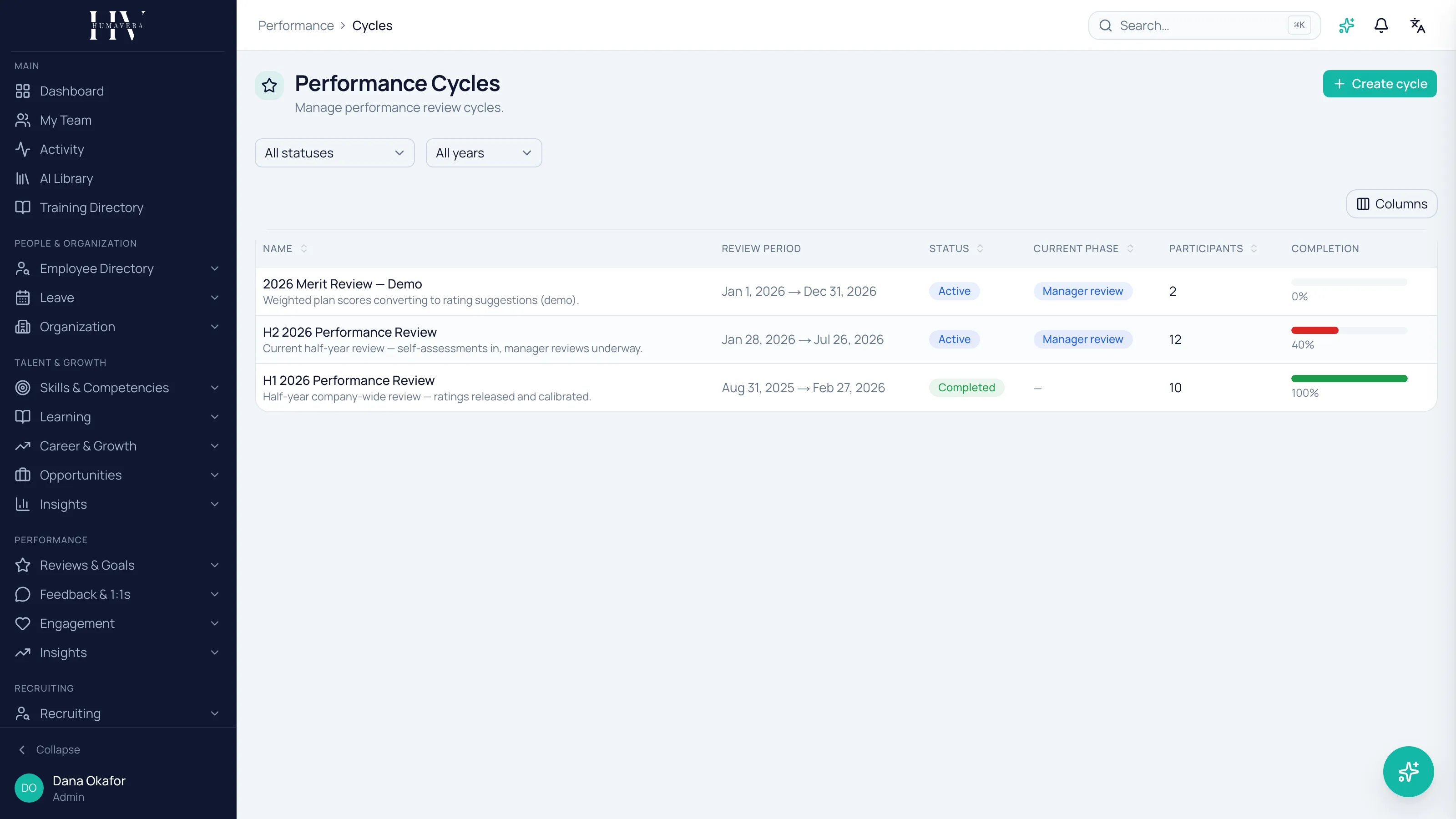
A cycle runs in phases
Section titled “A cycle runs in phases”A review is not one event. A cycle moves through phases, and the phase decides who can act and what anyone can see.
| Option | Description |
|---|---|
| Self | Employees assess their own performance. |
| Manager | Managers rate their reports and tie the rating to goals. |
| Calibration | Ratings are normalised across teams so they mean the same thing. |
| Release | HR publishes results, and only then do employees see them. |
Example: Olivia Bennett rates her engineers during the manager phase. James Whitfield cannot see her rating or her comments until HC Corp releases the cycle.
The release gate
Section titled “The release gate”This is the single most important behaviour in the section. Manager ratings and comments stay hidden from the employee until HR explicitly releases the cycle.
It exists because ratings change during calibration. An employee who saw a draft rating and then saw a different final one would be right to ask which was real, and the answer would damage trust in the whole process.
Example: if Olivia Bennett’s initial rating for James Whitfield is adjusted during calibration, he sees only the final released result — not the draft that preceded it.
Once results are released, employees acknowledge them, which records that the conversation happened.
Calibration
Section titled “Calibration”Calibration sessions normalise ratings across teams before release, so a “strong” from one manager means what a “strong” from another does. Sessions can be locked once agreed. Calibration is available on the Enterprise and Enterprise Plus plans.
What ratings are argued from
Section titled “What ratings are argued from”A rating is more defensible when it points at something recorded during the year rather than at a manager’s memory of it.
| Option | Description |
|---|---|
| Goals and OKRs | Objectives with key results and check-ins, alignable up and down an org-wide cascade tree. |
| Operational KPIs | Perpetual red, amber, and green metrics with measurement history and a trend, rather than a target that closes. |
The distinction matters. A goal is something you finish; a KPI is something you hold. Example: “launch the new billing service this quarter” is a goal for James Whitfield. “Keep incidents under an agreed threshold” is a KPI — it never completes, it either stays green or does not.
Rating scales
Section titled “Rating scales”Scales are configurable rather than fixed, with your own labels, colours, and a flag for which points count as acceptable. Define the scale before a cycle opens, because changing it mid-cycle changes what ratings already given mean.
When performance is not good enough
Section titled “When performance is not good enough”A Performance Improvement Plan runs from draft to activation, through checkpoints, to a recorded outcome. Its outcomes reach outside this section: an outcome can confirm a probation decision or route to a termination request, rather than ending in a document nobody acts on. Create a performance improvement plan covers drafting one, and run and close a performance improvement plan covers everything after that.
Rewards follow from ratings
Section titled “Rewards follow from ratings”Performance-based rewards decide eligibility by rule — combining performance tier with discipline history — and freeze the result as an immutable snapshot. Employees get a transparency view showing how their own outcome was reached: read your rewards covers what it shows and why a projected figure is not yet final.
What happens next
Section titled “What happens next”Ratings feed compensation: merit proposals are argued from performance, and reward eligibility is calculated from it. Rating history accumulates per employee and per team across cycles, which is what makes promotion and succession discussions evidence-based rather than anecdotal.
Related
Section titled “Related”© 2025-2026 Humavera Documentation - BPilot Ltd. All Rights Reserved