

Leave
What this achieves
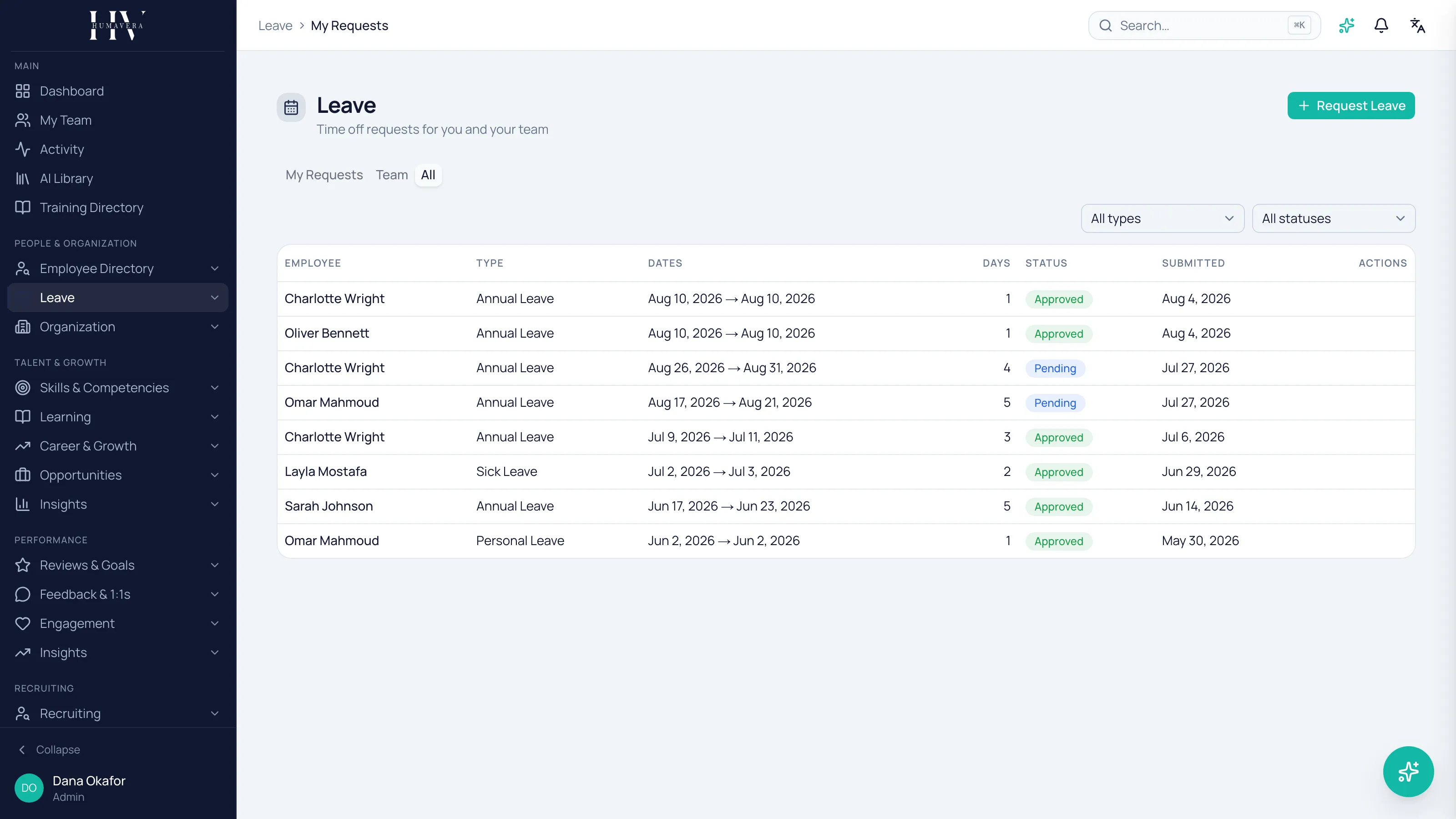
Section titled “What this achieves”Leave covers the time your people are entitled to take off and the process for requesting and approving it. Humavera holds the rules for each type of leave, calculates what each person has left, and routes requests to whoever needs to approve them.
Leave types carry the rules
Section titled “Leave types carry the rules”A leave type is more than a label on a request. Each type carries the policy that governs it, which is what allows balances to be calculated rather than tracked by hand.
| Option | Description |
|---|---|
| Accrual | How entitlement builds up over time. |
| Eligibility | Who may take this type, based on criteria such as tenure or level. |
| Carryover | What happens to unused balance at the end of a period. |
Example: HC Corp gives annual leave that accrues monthly, while a long-service type only becomes available after a tenure threshold — so a new joiner sees annual leave but not the second type.
Because eligibility is checked against the employee record, a request for something the person is not entitled to is caught when it is submitted rather than at approval.
Requests route for approval
Section titled “Requests route for approval”A leave request follows your organization’s approval route. That may be the employee’s manager, or a longer path where you have configured one, including deadlines and escalation if it is not actioned.
Example: when James Whitfield requests leave, it reaches Olivia Bennett as his manager. If she is away and has delegated her approvals, it reaches the person she delegated to, and the delegation is recorded.
Managers can also submit leave on behalf of someone who cannot do it themselves.
HR can record leave that has already happened
Section titled “HR can record leave that has already happened”Real absence does not always arrive through the system in advance. Someone is taken ill, or a manager agrees something verbally and it is recorded afterwards. HR can create and approve retroactive leave in a single audited action, which keeps balances accurate without inventing a fake request dated in the past.
Example: if Tom Hargreaves is off sick on 12 January 2026 and reports it by phone, HR records that absence directly rather than asking him to submit a request for a date that has passed.
Balances
Section titled “Balances”Balances are held per leave type, so annual leave and sick leave are counted separately rather than drawn from one pool. Who can see whose balance follows the usual scoping: employees see their own, managers see their team’s, and HR can see anyone’s.
Balances can also be adjusted manually or re-initialised where a correction is needed. Both are deliberate administrative actions rather than side effects of editing a record.
The team calendar and public holidays
Section titled “The team calendar and public holidays”Approved leave appears on a month-view calendar so a manager can see coverage rather than approving each request in isolation.
Public holidays are held separately and can be scoped to a location or department, which matters where your people are not all in one country. Recurring holidays can be generated ahead rather than entered year by year.
Example: HC Corp UK Ltd’s London staff and HC Corp Inc.’s staff observe different public holidays, so each is scoped to its own location rather than applied to everyone.
What happens next
Section titled “What happens next”Leave feeds payroll: unpaid leave reduces pay, and where time and attendance is in use, reconciled days distinguish present from absent from on-leave. It also feeds the team calendar managers plan around. Set your leave types and holidays up before your first pay run, because a balance that is wrong at the point of payment is harder to correct than one caught beforehand.
Related
Section titled “Related”© 2025-2026 Humavera Documentation - BPilot Ltd. All Rights Reserved